What Happens Before Your Insight Appears
Most health tools hand you charts and leave the interpretation to you. Preffect reads the data for you, tells you what it found, and shows you exactly how it got there.
That last part matters. Ananya, who built Insights, put it plainly: when she glances at a chart in another health tool, her first question is, "What are you trying to tell me?" The second is, "Can I actually trust this?" Insights was built to answer both, every time.
Layer one: your data, brought together
Insights starts by pulling together everything you share. That includes what you log in Preffect, and what flows in through Apple Health from any other tool you use. Think of each source as a piece of a puzzle. Separately they tell you something small. Together they can tell you something real.
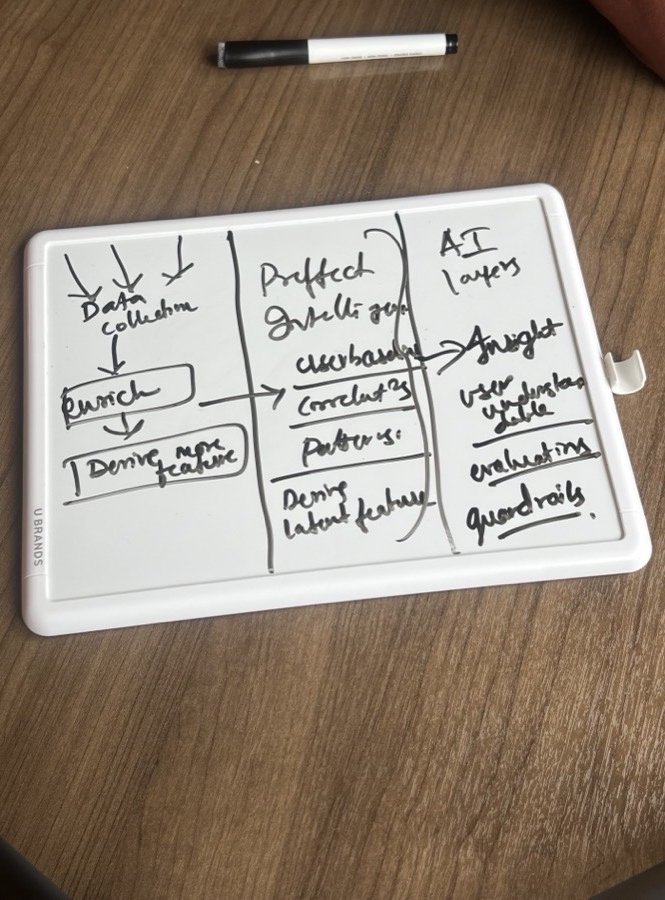
Once the data is collected, it gets enriched. Two or three variables that make sense together get combined into a single, more meaningful signal. Groups of related things get bucketed into categories. What comes out of this step is a cleaner, richer picture than any single data stream could give you on its own.
Hidden inside that picture are what Ananya calls latent features. They are there in your data, but you cannot see them without statistical analysis. The first layer finds them. Then it passes everything to the layer where the real work begins.
Layer two: the intelligence layer
This is the layer Ananya calls the golden layer. It is where Preffect builds a real understanding of you.
It starts with your baselines. Not population averages or clinical reference ranges published for a broad group of people. Your baselines. What your numbers look like across the last 30 days, 60 days, 90 days, and going back as far as your data goes. That history never resets. It grows. Every week you use Preffect, the intelligence layer has a fuller picture to work with.
On top of those baselines, Preffect looks for correlations between your variables, and then for patterns. Some patterns show up in a single metric. Others only appear when you look at several metrics together over time. The intelligence layer finds both, and it keeps refining its understanding as your data grows.
"The thing most people don't realize about Insights is the amount of work that happens behind the scenes with your data."— Ananya, Preffect
Layer three: insights you can actually use
Everything the intelligence layer finds gets handed to the AI layer. But this is not a system that reads your data and free-associates. It is grounded. There are evaluation pipelines that check every generated insight against the underlying data before it reaches you. If the data does not support it, it does not ship.
When Preffect surfaces an insight, it also tells you how it found it. When it makes a recommendation, it explains why. Not because showing your work is a nice touch, but because trust has to be earned. You should never have to wonder whether what you are reading is real.
What this looks like in practice
Ananya tested Insights on her own data. What came back was this: her late evening workouts had been affecting her recovery the next day. The system had found two distinct patterns. Late workouts correlated with lower recovery. Earlier workouts correlated with better recovery. It put those two findings together and recommended she move her workouts earlier by at least 60 minutes.
She had recently shifted her workout schedule. She had noticed she felt lower energy the following mornings. She had not connected the two until Insights did it for her. "I would have never figured it out otherwise if nobody had come and told me this," she said. "Which Insights did."
That is the point. Not a number to track. Not a chart to interpret. Something you can actually do.
A note on your data. Everything Insights learns stays yours. Your baselines and patterns are built from your data alone, and they are used only to give you better insights over time.
The more data you share over time, the more Preffect can see. After a year of use, or two, or three, the picture becomes something no chart could show you on its own.