You didn't fail your health app. It failed you.
If you have ever downloaded a health app, used it hard for three weeks, and then quietly let it die on your home screen, this is for you. That was not a willpower problem. It was a design problem, and it was not yours.
Here is how it usually goes. You download the app with a real reason. You want to sleep better, or get back into running, or stop crashing every afternoon. The first thing the app asks is your goal. You pick one. From that moment on, the entire app arranges itself around that single number, and every screen exists to march you toward it.
For a couple of weeks it feels good. Then one of two things happens.
Maybe you hit the goal. And the strangest thing occurs: the app goes quiet. It was built to get you to a finish line, and now that you are there, it has nothing left to say. The reason to open it is gone.
Or maybe you don't hit it. Life gets busy, the number stops moving, and every time you open the app you feel the gap a little more. So you stop opening it. Not because you stopped caring about your health, but because the app turned your health into a scoreboard you were losing.
Either way, you drift off, and you carry a small quiet sense that you failed. You didn't. The app did. It was built around a goal, and a product built around a goal has no idea what to do with you once the goal is reached, or missed, or simply changes.
And here is the thing almost every health app gets wrong.
Your goals change, because you are a person, and that is what people do.
A goal is a hypothesis, not a contract
This is the idea we built our whole product around. A goal is not a contract you sign and can fail at. It is a hypothesis about what you want right now, and like everything else about a person, it is allowed to change.
You might arrive wanting to run a 5k and, six months later, care most about sleeping through the night. You might set out to lose weight and discover that what you actually needed was more energy in the afternoon. None of that is failure. That is just being a person over time.
A product built around a goal treats every one of those shifts as a reset. Start over. Pick a new goal. Rebuild your streak. A product built around you treats them as what they are: you, changing, which is the most normal thing in the world.
That single distinction changes everything downstream.
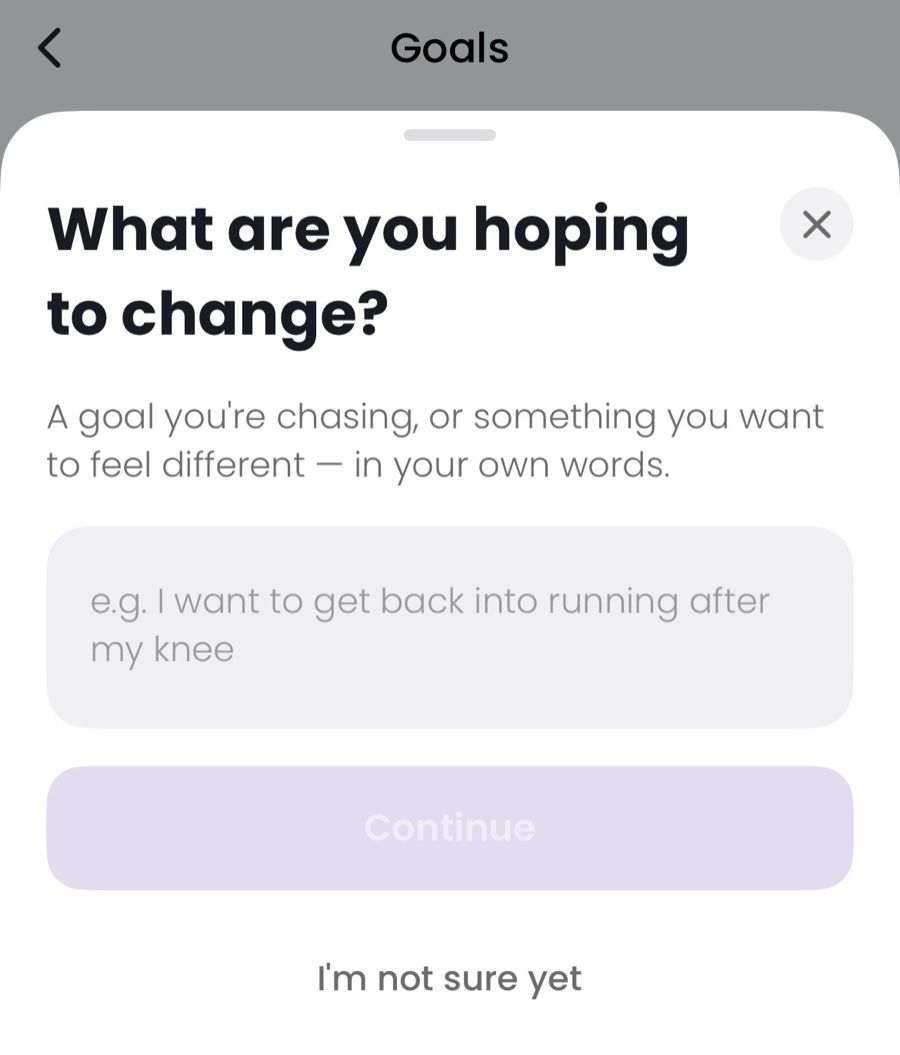
It means we listen for what you actually want, in your own words, instead of handing you a menu of six generic goals to tick. "Get back into running after my knee" is a real goal. "Improve physical fitness" is a form field.
It means that when you finish something, we notice, we celebrate, and we ask what is next, instead of falling silent. The finish line becomes a doorway, not an exit.
It means that when your life shifts, we can see it in your patterns and meet you where you actually are, instead of nagging you about a goal you quietly let go of three weeks ago.
And it means we hold ourselves to a different measure. Not how many days in a row we got you to open Preffect, but whether your life actually got better. Streaks are easy to manufacture. Real change is harder, and it is the only thing worth building.
Built around you
Most health tech treats you as a means to a metric. Hit the number, keep the streak, come back tomorrow. We would rather treat the metric as a means to you.
So we did not build Preffect around a goal. We built it around the person holding the goal, which is to say, around you. Your goals can come and go, sharpen, soften, and change completely, and Preffect stays useful the whole way through, because the thing it is actually organized around is not a number on a screen. It is you.
You are not a goal to be completed. You are a person, and you are allowed to change. Preffect is built for that.