Why your wearable score doesn’t match how you feel
Your ring says you are recovered. You feel like you were hit by a bus.
One of you seems to be wrong, and most people quietly assume it is them. It is not. Both readings can be perfectly accurate. They are answering different questions.
Why your score and how you feel disagree
A readiness or recovery score answers the question “how does this measurement compare to a reference range?” How you feel answers the question “how is this Tuesday going, for me, given everything else in my life right now?”
Those are different questions, so they can have different answers on the same morning without either being broken.
A number built from broad reference ranges is genuinely useful. It is stable, it is comparable, and it catches the big stuff. What it cannot tell you is whether six hours and fourteen minutes is a bad night for you, because that depends on what your last ninety nights looked like. Seven hours might be a rough night for one person and a good one for another. A population cannot tell those two people apart. Only their own history can.
So when your score and your body disagree, the useful move is not to pick a winner. It is to ask what the score does not have access to.
What a personal baseline actually is
A personal baseline is a picture of what normal looks like for you specifically, built from your own data over time rather than from averages published for a broad group of people.
In Preffect, that means your last 30 days, your last 60, your last 90, and as far back as your data goes. Not clinical reference ranges. Not the average of everyone who owns the same device as you. Yours.
The practical difference shows up in what counts as unusual. If your resting heart rate has sat in a narrow band for three months and it moves four points, that is a real signal for you, and it can be entirely invisible inside a population range where four points is noise. The reverse happens too. A number that looks alarming against a reference range can be completely ordinary for you.
The other thing worth knowing is that a baseline is not a fixed reading. It deepens. Every week of data you add gives it more to compare against, which means the same system gets more specific about you over time without asking anything more of you.
“A population average tells you whether you’re normal for someone your age. Your own baseline tells you whether you’re normal for you, and only the second one is worth acting on. Two people can come out of a hard week looking identical on paper. For one it’s an ordinary dip they’ll shake off by Thursday. For the other it’s the deepest they’ve been in months, and they aren’t bouncing back. A population average reads those as the same thing.”— Ananya Joshi, ML Engineer, Preffect
The signals your wearable never sees
Your wearable is very good at measuring your body, and it has almost no information about your life.
It does not know that you had six meetings back to back. It does not know that you ate at 10pm because that was the only gap. It does not know that it has been grey and raining for nine days, or that you are three days from a deadline. None of that shows up on your wrist, and all of it changes how a day feels.
This is usually the real answer when a good score and a bad morning collide. The score measured your body accurately. It just did not have the context that would explain the gap.
Weather is the one that surprises people. A heavy, low pressure morning or a long run of dark days is the kind of thing you feel clearly and struggle to account for, because there is nothing in your health data that points at it. Plenty of people notice they feel flatter in that weather. Almost nobody has a way to see it sitting next to their sleep and their activity, where it might actually explain something. It is context, not a diagnosis. Sometimes context is the whole answer.
What changes when you look across signals instead of at one
Some patterns only exist between metrics. Look at any single number and they are invisible, however carefully you look.
Ananya Joshi, the ML engineer who built Insights, ran it on her own data. It surfaced two patterns. Her late evening workouts lined up with lower recovery the next day. Her earlier workouts lined up with better recovery. On their own, either finding is mildly interesting. Together they point at something you can act on, which is why the recommendation that came back was specific: move your workouts at least 60 minutes earlier.
She had already noticed the flat mornings. She had recently shifted her workout schedule. She had not connected the two.
That is the difference between measurement and interpretation. Her ring measured everything correctly the whole time. Nothing was missing from the data. What was missing was somebody looking across it.
“Everybody’s racing to measure more, and the measuring is already fine. Nobody’s putting your late workout next to your bad night next to your calendar and saying it’s one story. That’s not a sensor problem, it’s an interpretation problem. But the expectations also rise: the moment you move from measuring to interpreting, you have to be specific and you have to be right. You can’t hide behind a recovery score and call it a day.”— Efrem Huang, Founder and CEO, Preffect
Why a goal changes what any of this means
The same finding supports different actions depending on what you are actually trying to change.
Take the late workout pattern. If what you want is to stop crashing in the afternoons, moving your session earlier is the obvious move. If you are training for something and the evening is the only time you have, the useful response is different: protect the recovery around it instead. Same data, same pattern, two reasonable answers. What separates them is what you are trying to do.
This is why Preffect asks what you are hoping to change, and asks it as a text box rather than a menu of six generic options. “Get back into running after my knee” is a real goal. “Improve physical fitness” is a form field. One of those tells us something. The other one is a category.
A goal here is a hypothesis, not a contract. It is allowed to change, because you are a person and that is what people do. When yours shifts, that is not a reset or a failure, it is just new information. And if you do not know yet, there is an “I’m not sure yet” button under the box, because not knowing yet is a real state and a perfectly good place to start.
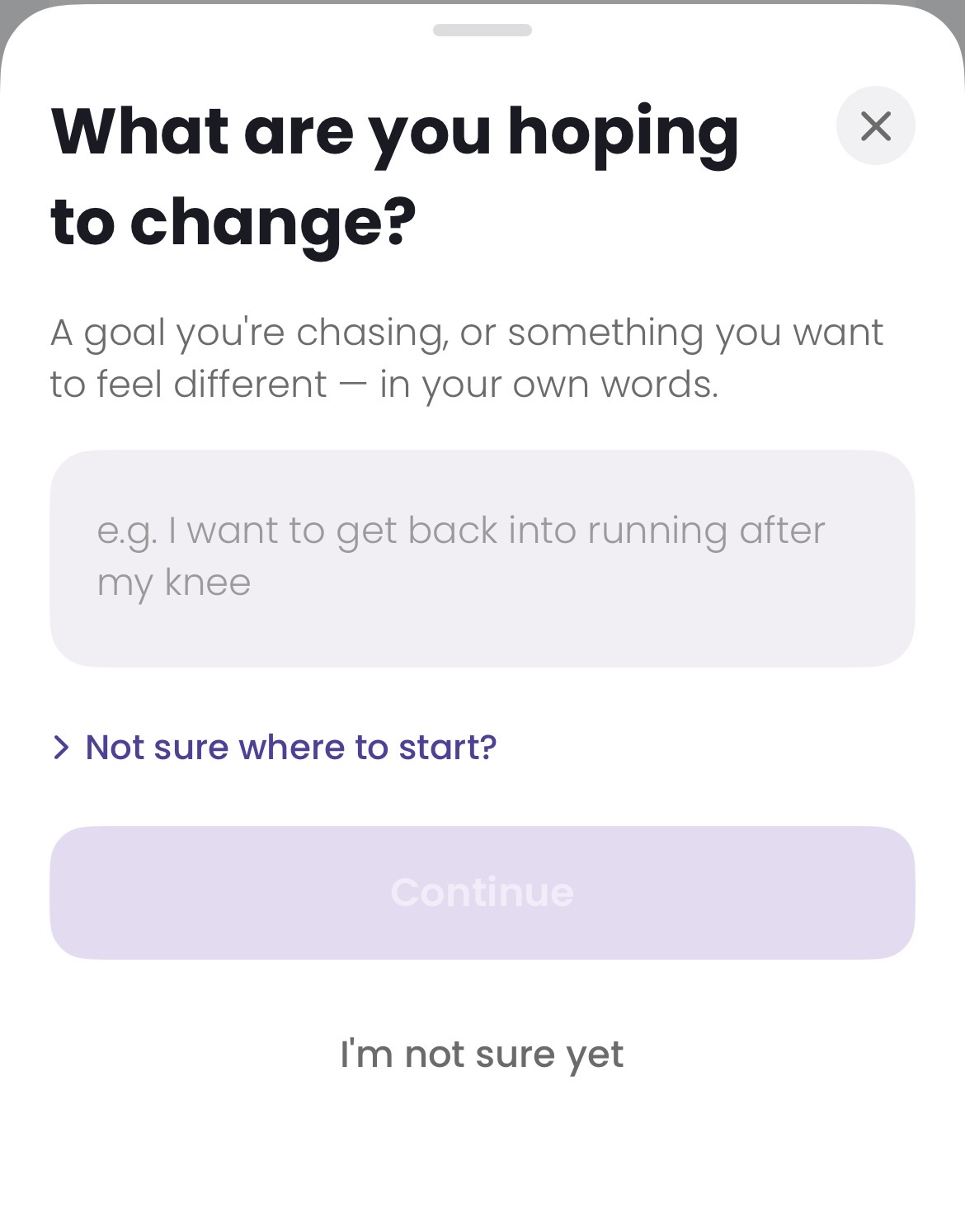
“It was the harder build. A menu is far simpler than interpreting real sentences and carrying the safety work that open input brings. But the specific thing someone types is what makes the whole thing theirs. Strip it down to a category and you’ve lost the only part that mattered.”— Ryanne Ramadan, Product Lead, Preffect
Which devices and signals connect
Preffect reads what you already have. Oura, Garmin, Fitbit, Polar, Apple Watch, and Apple Health all connect directly, so whatever is already on your wrist or your finger most likely fits.
Beyond the devices, it also reads your calendar for the shape of your days, Clue for cycle context, and your local weather. You can log a meal or a workout with a photo or a sentence, which covers the days you are not wearing anything at all.
You choose what Preffect can read. You can change your mind later, and what it learns is built from your data alone and used only to give you better insight over time.
The data you already have is the point
Most people wearing a ring or a watch are sitting on years of their own history, and almost none of it has ever been read properly.
And connecting one is not a fresh start either. When you connect a wearable, Preffect backfills your last 90 days rather than beginning from the day you signed up. Your first morning is not built on a single night of data. It is built on a season of your own, and it keeps growing from there.
That is the part worth sitting with. You do not need a new device, a new routine, or a better month to start. The record already exists. It has been accumulating quietly this whole time, including through every stretch where you stopped paying attention to it. History does not reset when you look away. It just gets longer.
“Once we know where your normal sits, we start learning how far you swing when something knocks you off it. Then how long you usually take to come back, and whether that’s changing. That takes months to learn, and it’s the one that changes what we can actually tell you: not just that something is off, but whether this is your usual dip and you’ll be fine in a couple of days, or whether it’s going deeper and lasting longer than it normally does.”— Ananya Joshi, ML Engineer, Preffect
Which means the useful question was never “what should I track next?” It was always “what has this been telling me?”
Common questions
Does Preffect work with Oura, Garmin, Fitbit, and Polar?
Yes. All four connect directly, along with Apple Watch and Apple Health. You do not need to move to a different device or use more than one.
Does Preffect import my history when I connect a wearable?
Yes. Connecting a wearable backfills your last 90 days, so Preffect starts with a season of your own data rather than from the day you connected. Your baselines keep deepening from there as more data comes in.
What is a personal baseline?
A picture of what is normal for you, built from your own data over time rather than from averages published for a broad group of people. In Preffect it spans your last 30, 60, and 90 days and as far back as your data goes, and it gets more specific the longer you use it.
Why is my recovery score different from how I feel?
Because a score compares your measurements to a reference range, while how you feel reflects your whole day, including things no wearable can see. Your calendar, the weather, what you ate and when, and how the last week has gone are all missing from that number. Both readings can be accurate at once.
Does weather really affect how tired I feel?
Many people notice they feel flatter during long grey stretches or heavy, low pressure days. Preffect reads your local weather as context alongside your health data, so that if it lines up with how your days are actually going, you can see it rather than guess at it. It is context, not a diagnosis.
What happens to my data if I stop using Preffect for a while?
Nothing is lost. Your data keeps accumulating in the background, and your baselines keep deepening whether or not you open anything. When you come back, it picks up where you left off. There is no catching up to do.
Your ring is not wrong. It is measuring one thing very well, and it was never given the rest of your life to work with.
That is the gap worth closing, and closing it does not take a new device or a better week. It takes somebody reading what you already have.